
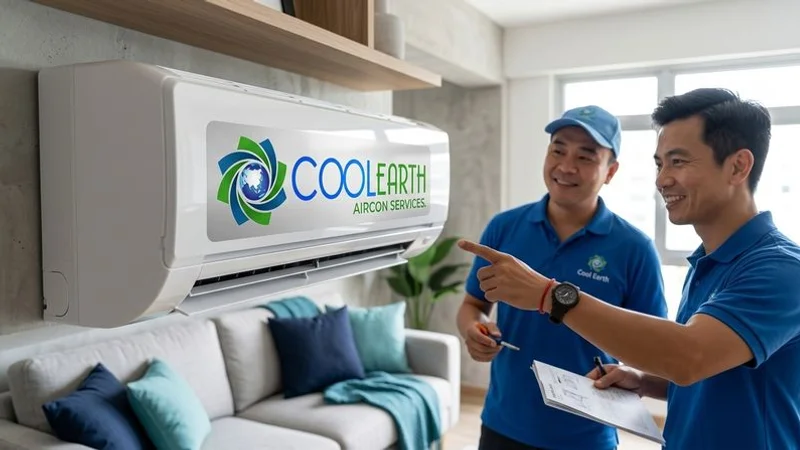
We know that selecting a cooling system is one of the biggest utility investments for any property.
The wrong choice guarantees years of inadequate cooling and shocking electricity bills. Our team at Cool Earth Aircon Services, your trusted provider of aircon servicing in Singapore, has seen every installation mistake imaginable since our founding in 2007.
You easily avoid these costly errors by following a clear selection process. We will guide you through exactly how to choose the right aircon for your HDB or condo in Singapore to secure comfortable temperatures and reasonable running costs for the next decade.
Let us examine the data and explore practical ways to respond to the tropical climate.
How to Choose the Right Aircon for Your HDB or Condo in Singapore: System Types
We always recommend evaluating your property layout before looking at specific brands. HDB flats and private condominiums have strict exterior constraints that dictate your equipment choices. Our installation crews frequently encounter homeowners who purchase units without checking their ledge dimensions first.
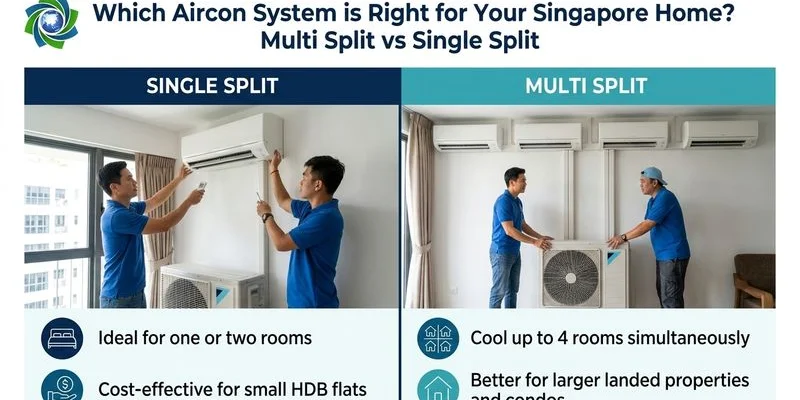
Multi-Split System (Most Common)
This is the standard choice for most modern housing. One outdoor condenser unit connects to multiple indoor wall-mounted units via refrigerant piping. We install “system 3” or “system 4” configurations daily.
A standard four-room HDB flat usually requires a System 3 setup to cover three bedrooms. Our technicians strongly suggest this route for balancing cost and convenience.
| Multi-Split Advantages | Multi-Split Drawbacks |
|---|---|
| Highly cost-effective for whole-home cooling | Each indoor fan coil requires separate servicing |
| Wide range of 5-tick NEA models available | Needs adequate space on a structural ledge |
Single-Split System
One outdoor condenser connects to exactly one indoor unit. This setup is perfect if you only need climate control in an isolated study room. Our commercial clients also use single splits for small server rooms.
You face higher space requirements outside because every indoor unit demands its own bulky condenser.
Ducted System (Centralised)
We rarely install these in standard public housing due to strict ceiling height constraints. A single powerful unit cools the entire home through concealed ductwork. Landed properties and luxury penthouses utilise this setup for clean aesthetics.
The initial installation costs are significantly higher than wall-mounted alternatives. Our data shows running costs also climb because users cannot easily isolate cooling to a single room.
Step 2: Get the BTU Sizing Right
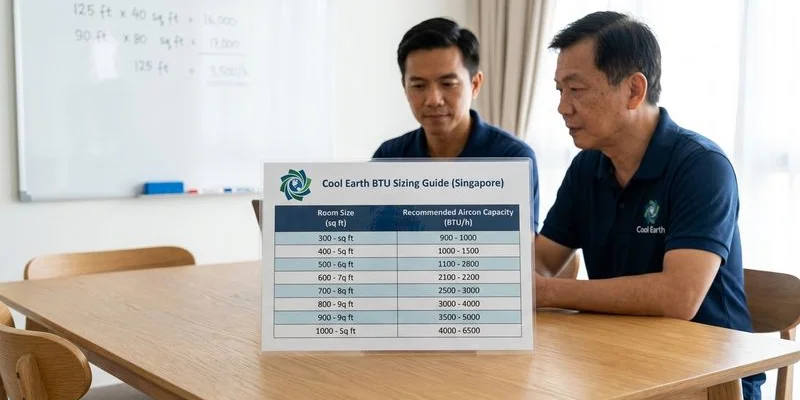
We consider accurate British Thermal Unit (BTU) sizing to be the foundation of reliable climate control. Choosing the wrong capacity drastically shortens the lifespan of your compressor. An undersized unit runs continuously without reaching the target temperature.
Our engineers see this lead to premature mechanical failure and wasted electricity. An oversized unit cools the space too rapidly and short-cycles. We created this baseline guide based on average tropical heat loads in 2026:
| Room Size | Recommended Capacity | Typical Room Type |
|---|---|---|
| 10-15 sqm | 9,000 BTU | Small bedroom or study |
| 15-25 sqm | 12,000 BTU | Master bedroom |
| 25-35 sqm | 18,000 BTU | Standard living room |
| 35-50 sqm | 24,000 BTU | Large open-plan living area |
Several environmental factors push your cooling requirements higher than these baselines. We always add 10 to 15 percent more capacity for rooms with west-facing windows. The direct afternoon sun in Singapore creates a massive heat load that standard calculations miss.
Rooms situated directly above hot kitchens or uninsulated roofs also demand stronger equipment. Our advice is to lean slightly higher when your calculations fall between two sizes.
Step 3: Choose Between Inverter and Non-Inverter
We field questions about compressor technology constantly. The choice directly dictates your monthly utility bills for the next decade. A comprehensive breakdown is available in our comparison of inverter vs non-inverter aircon setups. We will summarise the financial impact here.
Modern inverter models continuously adjust their motor speed to match the exact cooling demand of the room. The compressor slows down to maintain the temperature instead of abruptly shutting off. Our tracking shows this variable-speed operation consumes 30 to 50 percent less electricity compared to older technology.
Here are the critical differences you must understand:
- Non-inverter models operate at maximum power until the thermostat trips, then restart aggressively when the room warms up.
- This constant on-off cycling wears out mechanical parts rapidly.
- The initial S$200 to S$400 premium for an inverter unit is typically recovered within 24 months of daily use.
We advise against purchasing non-inverter units for any residential property.
The Power of the 5-Tick NEA Rating
We urge buyers to look closely at the National Environment Agency (NEA) energy label. The agency mandates these ratings to help consumers gauge long-term running costs. A 5-tick rating indicates the highest level of energy efficiency available in the market.
Our latest 2026 installation data shows that upgrading from a basic 2-tick model to a 5-tick system saves households up to S$300 annually. You will quickly recoup the higher upfront purchase price through these monthly SP Group bill reductions. We strongly recommend 5-tick units for primary bedrooms where the system runs for eight hours every night.
Step 4: Select a Brand
We install every major manufacturer operating in the local market. The technicians on our team see exactly which units survive the tropical humidity and which ones require constant repairs. The right brand depends heavily on your specific priorities regarding noise, filtration, and budget. We evaluated the leading options based on our service call data.
Premium Japanese Performers
We consider Daikin and Mitsubishi Electric to be the undisputed leaders for residential properties. Daikin provides exceptional energy efficiency with their popular iSmileEco series. Their units feature Streamer Discharge technology and built-in PM2.5 filters to actively purify indoor air.
Our customers frequently praise Mitsubishi Electric for manufacturing the quietest systems available. The legendary Starmex series operates at an ultra-quiet 19 decibels. You will barely hear the compressor running, making it the perfect choice for light sleepers.
Reliable Mid-Range Contenders
We often recommend Panasonic for buyers seeking excellent value without sacrificing reliability. Their latest XU series utilises nanoe-X technology, which neutralises airborne pollutants highly effectively. Panasonic delivers strong inverter performance at a slightly lower price point than the premium Japanese brands.
Our team appreciates LG’s seamless smart home integration and intuitive mobile application. LG offers stylish designs equipped with dual inverter compressors for rapid temperature drops. Samsung competes strongly with its proprietary Wind-Free technology. We applaud this feature for dispersing air gently through thousands of micro-holes to eliminate harsh cold drafts.
Budget-Friendly Alternatives
We suggest Midea for investment properties or guest rooms that see infrequent use. The brand has improved its manufacturing quality drastically and offers very competitive pricing. Their units provide reliable basic cooling, though they lack the advanced filtration found in premium models.
Step 5: Consider Your Budget
We know that financial planning is crucial for any major home improvement project. The total bill depends on the equipment brand, the number of blowers, and the piping complexity. A transparent breakdown is available in our guide covering aircon installation costs in Singapore. We compiled these average 2026 market rates to help you budget for a standard multi-split configuration:
| Configuration | Budget-Friendly Tier | Mid-Range Tier | Premium Tier |
|---|---|---|---|
| System 2 | S$1,800 to S$2,200 | S$2,200 to S$3,000 | S$3,000 to S$4,000 |
| System 3 | S$2,500 to S$3,000 | S$3,000 to S$4,000 | S$4,000 to S$5,500 |
| System 4 | S$3,200 to S$3,800 | S$3,800 to S$5,000 | S$5,000 to S$7,000 |
These estimates cover the supply of equipment and standard trunking work. We must point out that extended pipe runs or chemical pipe concealment require additional funds. Your final quote will also increase if you need custom stainless steel brackets installed outside.
Step 6: HDB vs Condo Considerations
We manage strict building regulations daily to ensure our clients remain compliant with local authorities. Public and private housing estates have vastly different rules governing exterior modifications. Failing to follow these guidelines results in hefty fines and mandatory equipment removal. We handle the necessary paperwork as part of our aircon installation service, but you should understand the basic constraints.
Public Housing (HDB) Rules
We strictly adhere to the Housing & Development Board regulations regarding ledge capacity. The authority mandates strict guidelines for exterior walls. Our technicians ensure compliance with these key restrictions:
- Condenser weight is strictly capped at 80kg to 110kg per wall panel depending on the block type.
- Refrigerant piping must run securely inside exposed PVC trunking along interior walls unless undergoing a full renovation.
- The chosen system must not exceed the approved electrical loading for older flats.
This restriction often limits homeowners to a single System 4 compressor.
Private Condominium Restrictions
We interface with Management Corporation Strata Title (MCST) offices to secure installation permits for private estates. Condominiums usually dictate the exact approved placement for your condenser units to maintain façade uniformity. You must also comply with Building and Construction Authority (BCA) noise limits.
Our preferred inverter models easily clear the boundary noise limit of 65 decibels during the day and 55 decibels at night. The whisper-quiet operation keeps your neighbours happy and compliant with the law. You must also verify if your building utilises a centralised chilled water system before purchasing standard split units.
Final Advice
We advise all homeowners to take their time evaluating these crucial cooling options. A poorly sized or inefficient unit will frustrate you and drain your wallet for years.
Always request detailed quotes that list exact model numbers rather than generic descriptions.
Our complete guide on how to choose the right aircon for your HDB or condo in Singapore provides the facts you need to make an informed decision. You can always reach out to our team for a complimentary on-site assessment of your property.
Let us design a highly efficient cooling solution that fits your exact layout and budget today.

About the Author
Brian
Founder & Lead Technician
Brian founded Cool Earth Aircon in 2007 after completing his technical apprenticeship. With 18 years of hands-on experience servicing aircon systems across Singapore, he leads a team of certified technicians committed to transparent, quality work.