
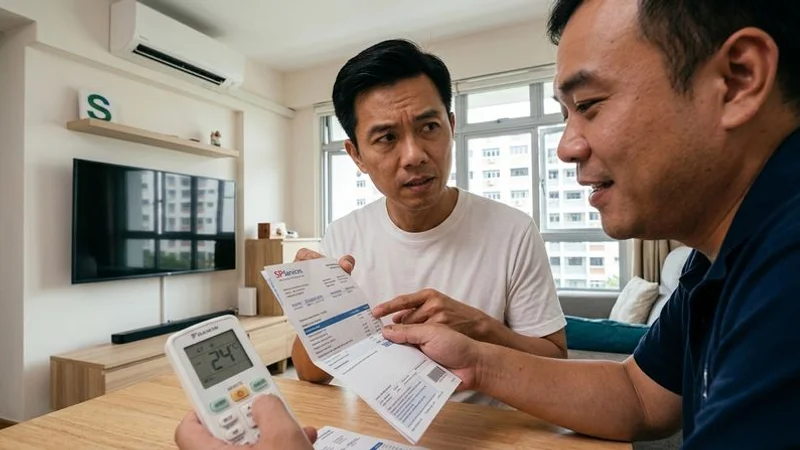
We know that opening your SP Group utility statement during the hotter months can be a stressful experience. The current Q1 2026 electricity tariff sits at 29.11 cents per kWh with GST. High cooling costs eat up a massive portion of your household budget.
Our team at Cool Earth Aircon Services has spent nearly two decades providing expert aircon servicing in Singapore and helping homeowners figure out how to reduce their aircon electricity bill. You do not actually need to switch off your system completely and suffer through the humidity to see real savings. Small adjustments to your habits and equipment will drastically cut your monthly expenses.
We are going to walk you through the data behind energy consumption and outline several practical steps you can implement today. Let us examine the exact temperature settings, maintenance routines, and hardware upgrades that make a genuine difference.
These verifiable facts will help you make smarter decisions.
1. Set the Temperature to 24-25°C
Our technicians frequently see clients blasting their units at 18°C because their rooms feel stuffy. This is the simplest and most impactful change you can make today. Every degree below 25°C increases your unit’s power consumption by approximately 3% to 5%.
We regularly remind customers that setting a thermostat to 18°C instead of the recommended 25°C can spike cooling costs by 20% or more. The National Environment Agency strongly recommends 25°C as the optimal temperature for energy efficiency.
A setting of 24°C is the sweet spot for most local residents, providing comfortable cooling while keeping electricity costs highly reasonable.
Our favourite trick is to combine that 24°C setting with a high-quality standing fan if the room still does not feel cool enough. Moving air creates a wind-chill effect that makes the space feel 2 to 3°C cooler on your skin. A model like the KDK PL30H living fan uses minimal electricity while circulating the cold air effectively.
2. Use the Timer Function Religiously
We highly recommend using the timer function to manage your overnight usage. Your aircon does not need to run continuously all night to keep you comfortable. Most people fall into deep sleep within 30 to 60 minutes of lying down.
Our research shows that your body’s temperature regulation changes during sleep, meaning you actually need less cooling in the deeper stages. Modern units like the Mitsubishi Electric Starmex feature a dedicated sleep mode that gradually increases the temperature by 1°C per hour.
Sleep Mode Advantage: This automatic adjustment achieves massive savings without waking you up.
We suggest a manual timer strategy if your remote lacks this specific sleep feature. Set the aircon to 24°C when you go to bed, and set the timer to switch off after 3 to 4 hours. The room will remain cool enough for comfortable sleep for at least 1 to 2 hours after the unit switches off.
Our clients who wake up feeling warm simply set a second timer to restart the unit 1 hour before they wake up. This approach cuts your overnight runtime from 8 hours to roughly 4 hours. A reduction like this translates to a 35% to 50% drop in overnight electricity consumption.
3. Keep Your Aircon Well-Maintained
We always warn property owners that a dirty aircon unit consumes significantly more electricity than a clean one. Dust and grime coat the evaporator coils, causing heat transfer efficiency to drop rapidly. The compressor is forced to work harder and longer to achieve the same cooling effect.
Our maintenance records show that unmaintained units consume 20% to 30% more electricity than clean models of the exact same age. For a household running three units, that translates to $40 to $80 per month in wasted electricity. You must stick to a strict cleaning schedule to prevent this unnecessary power drain.
We advise following these specific maintenance intervals for the best results:
- Bi-weekly filter cleaning
- Quarterly professional servicing
- Annual chemical washes
A deep chemical wash removes stubborn grime from the internal evaporator coils. In 2026, a proper chemical wash typically costs between $85 and $150 per wall-mounted unit.
We find that this preventative step stops you from needing a full chemical overhaul later, which can cost upwards of $150 to $250 per unit. If you have not serviced your system in more than three months, booking a professional servicing is incredibly cost-effective.
The money saved on your electricity bill will easily cover the cost of the servicing.
4. Close Doors and Windows
Our installers are constantly surprised by how often homeowners run their cooling systems with the bedroom door open. Every gap allows cool air to escape and warm, humid air to enter the room. The compressor has to work constantly to compensate for this endless heat load.
We always check for proper room sealing during our initial site assessments:
- Keep all doors and windows in the cooled room firmly shut.
- Apply weather strips to close the gaps under your doors.
- Draw curtains or blinds on windows that receive direct sunlight.
Solar heat gain through standard HDB glass windows is a major additional burden on your system. Installing blackout curtains blocks direct sunlight during the afternoon perfectly.
Our top advice for closing gaps is to apply 3M self-adhesive silicone door seals to the bottom of your bedroom doors. A simple silicone strip costs less than $10 online but traps the cold air beautifully. This tiny investment stops the hallway heat from creeping into your chilled space.
We guarantee you will feel the room cool down much faster once the space is properly sealed. Your compressor will finally be able to cycle down and rest.
Less running time directly equals lower power consumption.
5. Ensure Proper Aircon Sizing
We consider an oversized or undersized unit to be a guaranteed energy waster. Undersized units run continuously at full power but cannot cool the room adequately. People end up lowering the temperature setting to compensate, which just wastes power.
Our technical team knows that oversized units cool the room too quickly, causing the compressor to turn on and off frequently. This short cycling draws a surge of electricity each time the motor restarts. The constant cycling prevents the unit from reaching its most efficient steady-state operation.
We calculate the required British Thermal Units (BTU) based on your specific floor plan to avoid this issue.
| Room Type in Singapore | Typical Size | Recommended Cooling Capacity |
|---|---|---|
| Standard HDB Common Room | 12 to 15 sqm | 9,000 BTU |
| HDB Master Bedroom | 15 to 20 sqm | 12,000 BTU |
| 4-Room HDB Living Room | 90 to 110 sqm | 18,000 to 24,000 BTU |
Matching the BTU rating to your square footage ensures optimal performance. If you suspect your unit is the wrong size, consult our guide on choosing the right aircon for detailed sizing guidelines.
6. Upgrade to an Inverter System
Our experience shows that if your property still uses a non-inverter fixed-speed model, you are paying a premium for outdated technology. These old units run at full speed until the room is cold, shut off completely, and then slam back on when it gets warm. Inverter units adjust their compressor speed continuously to match the exact cooling demand.
We strongly advise upgrading to an inverter system to reduce your cooling electricity consumption by 30% to 50%. Advanced models like the Daikin iSmileEco series use R32 refrigerant and intelligent sensors to operate with incredible efficiency. The additional upfront cost of the inverter equipment is typically recovered within the first year of use.
Our calculations show that a typical 3-unit household can save $80 to $120 per month by making this switch. For a detailed technical comparison, see our article on inverter vs non-inverter aircon.
The energy efficiency gains from this hardware upgrade are impossible to ignore.
7. Check Your Energy Label Rating
We constantly remind buyers that since 2008, all units sold locally must display a National Environment Agency (NEA) energy label. The rating system uses green ticks to indicate efficiency, ranging from 1 tick up to 5 ticks. Each additional tick represents approximately 5% to 10% better energy efficiency.
Our advice is to always opt for the highest tick rating your budget allows when purchasing new equipment. In 2026, a modern 5-tick multi-split system costs about $500 per year to run for an average household. An older 3-tick system from 2018 easily consumes over $820 annually in electricity.
We love showing clients how that $320 annual difference easily offsets the slightly higher purchase price of the premium model. The price gap between a 3-tick and 5-tick unit is typically only $100 to $300 at the store. For a deeper understanding of these metrics, see our guide on understanding aircon energy labels.
8. Use Fan Mode Strategically
Our technicians want you to know that your remote control has a fan mode setting that only runs the indoor blower without engaging the compressor. This specific mode uses a tiny fraction of the electricity required for full cooling. Fan mode consumption sits at roughly 30 to 50 watts, compared to the massive 800 to 1,200 watts used during cooling.
We recommend using this mode when the room is already cold and you just want some basic air circulation. It is also perfect for the rare cooler monsoon evenings when the outdoor temperature drops nicely.
Running the fan dries out the internal evaporator coils after a long cooling cycle.
The Anti-Mould Benefit
We always teach this quick drying trick to help prevent that sour, dirty sock smell from developing. Moisture left on dark, cold coils creates the perfect breeding ground for mould and bacteria. A dry coil stays cleaner for a longer period, extending the time between required chemical washes.
9. Consider Your Home Layout
Our interior layout checklist helps clients identify hidden thermal traps that ruin cooling efficiency. The thermostat sensor inside the indoor unit is highly sensitive to external heat sources. Small changes to your furniture and electronics placement will naturally improve performance.
We frequently find heat-generating appliances like OLED televisions or gaming computers placed directly below the blower:
- Move lamps and televisions away from the indoor unit.
- Keep tall wardrobes away from the top air return opening.
- Ensure at least 15 centimetres of clearance above the unit.
The rising heat tricks the sensor into thinking the room is much warmer than it actually is. This causes the machine to overcool the space, wasting a significant amount of power.
We see massive performance drops when dust or objects block that top air return vent. Obstructing the return air forces the blower fan to struggle to pull in enough air.
A clear, unobstructed airflow path is critical for optimal heat exchange.
The Combined Impact
Our analysis proves that while each individual tip saves 5% to 15%, the combined effect is absolutely substantial for your household budget. A family implementing proper temperature settings, timers, and regular maintenance can reduce their usage by 40% to 60%. On a typical Singapore electricity bill where cooling accounts for $100 to $200 per month, that translates to savings of $40 to $120 monthly.
We want you to keep that extra $480 to $1,440 in your bank account over a full year. Start with the free changes first, like adjusting your thermostat and closing the doors. You can then invest in professional maintenance and hardware upgrades as your budget allows.
We are ready to help you achieve the perfect balance of comfort and efficiency. The financial returns on these actions are real, measurable, and immediate. If you need help optimising your setup to reduce your aircon electricity bill in Singapore, contact Cool Earth Aircon for a professional assessment.
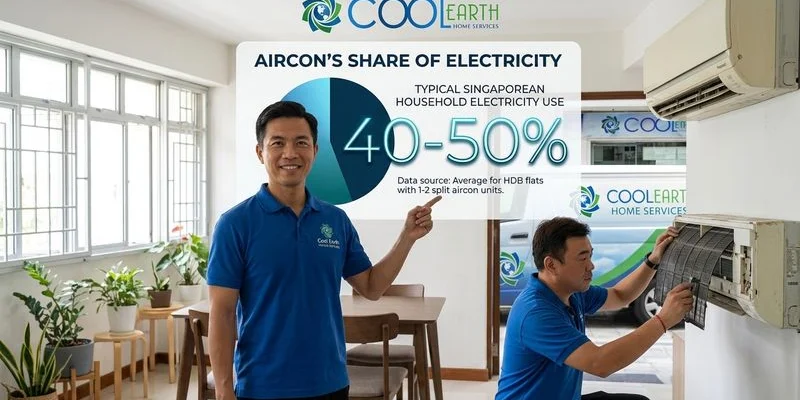


About the Author
Brian
Founder & Lead Technician
Brian founded Cool Earth Aircon in 2007 after completing his technical apprenticeship. With 18 years of hands-on experience servicing aircon systems across Singapore, he leads a team of certified technicians committed to transparent, quality work.