
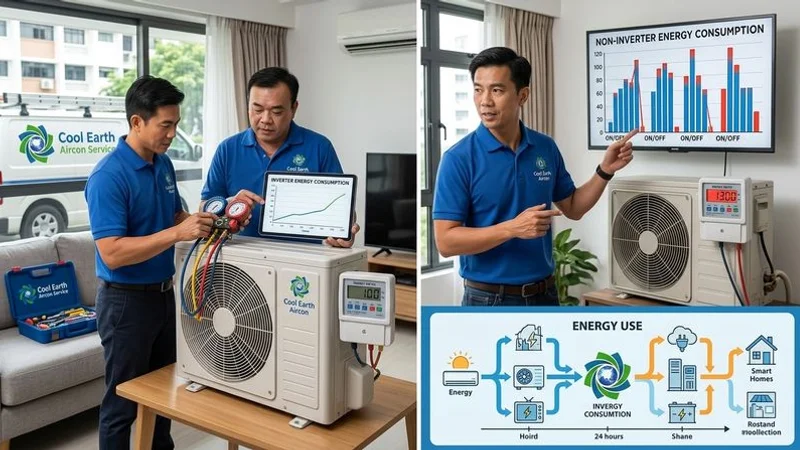
When homeowners ask us to settle the debate of Inverter vs Non-Inverter Aircon in Singapore: Which Should You Choose?, we always clarify that this distinction is not just a marketing gimmick. Our team at Cool Earth Aircon Services has been providing expert aircon servicing in Singapore since Brian founded the company back in 2007. The technology you choose directly affects your daily comfort, your monthly electricity bill, and the lifespan of your cooling system. We have witnessed exactly how these different compressors perform across thousands of local HDB flats and condominiums. Let us look at the data and explain what is actually happening inside your unit.
How Non-Inverter (Fixed-Speed) Aircon Works
A non-inverter aircon features a compressor that operates at one fixed speed. When you switch on the unit and set your remote to 24°C, the compressor kicks on at maximum capacity. It runs at full power to cool the room down.
Our technicians often explain this process using a car analogy. Imagine driving a vehicle by exclusively pressing the accelerator straight to the floor or taking your foot off completely. You alternate strictly between maximum speed and coasting to a halt.
Once the room reaches that target 24°C, the compressor switches off completely. Heat gradually seeps back into the room through sunlight, warm walls, or simply body heat. The thermostat eventually detects this temperature rise and switches the compressor back on at full speed.
Characteristics of Non-Inverter Systems
This constant on-and-off cycle creates several distinct side effects for the user. We see these specific issues repeatedly in older Singaporean homes.
- Temperature fluctuation: Room temperatures swing between 1°C and 3°C above and below your set point.
- The inrush current spike: Each startup draws a massive surge of power, often pulling 6 to 8 times the normal running amps for a split second.
- Higher energy consumption: Those repeated 40-amp power spikes consume significantly more electricity than a steady run.
- Phased-out availability: Due to the National Environment Agency (NEA) raising Minimum Energy Performance Standards, finding new multi-split non-inverter models locally is increasingly difficult.
How Inverter Aircon Works
An inverter aircon uses a variable-speed compressor managed by an electronic circuit board. Instead of running at full throttle or shutting down completely, the compressor adjusts its speed continuously. This matches the exact cooling demand of your room at any given moment.
Our preferred car analogy for this technology is cruise control. The engine adjusts its power output smoothly to maintain your desired speed without ever stopping or redlining.
When you set your target temperature to 24°C, the compressor initially runs fast to cool the space quickly. Once that target is reached, the system slows down to a low-speed maintenance mode. If someone opens a door and lets warm air in, the compressor speeds up just enough to compensate.
Characteristics of Inverter Systems
Modern variable-speed units offer a completely different user experience. The integrated sensors and microprocessors deliver precise climate control.
- Stable temperature: The room stays within a tight 0.5°C band of your chosen setting.
- Soft-start logic: The system ramps up voltage gradually, entirely avoiding the massive power spikes that wear down fixed-speed components.
- Advanced motor tech: Brands like Daikin utilise Pulse Amplitude Modulation (PAM) to boost cooling speed efficiently.
- Lower energy consumption: These systems use 30% to 50% less electricity compared to fixed-speed models of the exact same capacity.
- Higher initial cost: You will typically pay a premium of $200 to $400 per unit upfront.
Energy Savings: The Numbers
Let us quantify the actual electricity savings using a real-world Singapore scenario. Our calculations use the SP Group residential tariff rate of $0.29 per kWh for the first quarter of 2026. Assume you run a standard 12,000 BTU bedroom aircon for 8 hours every night.
| Feature | Non-Inverter (Older 2-Tick) | Inverter (NEA 5-Tick) |
|---|---|---|
| Average Power | 1.0 kW | 0.6 kW |
| Daily Usage | 8.0 kWh | 4.8 kWh |
| Monthly Usage | 240 kWh | 144 kWh |
| Monthly Cost | $69.60 | $41.76 |
This side-by-side comparison shows a monthly saving of $27.84 per individual unit.
For a typical HDB System 3 setup, those annual savings accumulate to roughly $1,002. Given that the price premium for choosing a 5-tick inverter System 3 over a basic model is usually $600 to $1,000, the upgrade pays for itself in exactly one year. Actual returns will vary slightly based on your room insulation and daily usage habits.
Comfort Difference
Energy efficiency usually dominates the conversation, but the physical comfort difference is equally significant. Our clients frequently complain about waking up sweating or freezing when using fixed-speed units. You might set the remote to 24°C, but the constant cycling means the actual room temperature bounces between 22°C and 26°C.
An inverter unit eliminates this frustrating cycle completely. The cooling is steady, uninterrupted, and tightly controlled within a half-degree margin. Many customers who upgrade specifically report better sleep quality as their favourite benefit.
Noise Levels
Non-inverter compressors are inherently louder because they always operate at maximum capacity. The sudden mechanical clunk of the compressor starting and stopping is highly disruptive in a quiet bedroom.
Inverter compressors run significantly quieter. Once the room reaches the set temperature, the motor settles into a low-speed maintenance mode that is barely audible. Premium inverter models from Mitsubishi Electric (like the Starmex series) and Daikin (like the iSmile range) operate at indoor noise levels as low as 19 decibels. For context, 19 decibels is comparable to the sound of gently rustling leaves.
Lifespan and Reliability
The constant start-and-stop cycling of a fixed-speed compressor creates immense mechanical stress. Each massive power surge generates heat and degrades electrical components like the start capacitor. Our service records indicate that an inverter compressor experiences far less mechanical wear and tear. Running smoothly at variable speeds extends the mechanical life of the system significantly. A well-maintained inverter system in Singapore typically lasts 10 to 15 years.
The Cost of Circuit Board Repairs
The primary vulnerability of an inverter unit is the Printed Circuit Board (PCB). This electronic brain manages the complex variable speeds, and it does not exist in basic fixed-speed units.
If an indoor PCB fails after the warranty expires, a replacement in Singapore currently costs between $350 and $600. Condenser PCB replacements can run even higher, depending on the specific brand and model. Modern inverter boards are highly reliable, and premature failures are uncommon if the unit is serviced regularly.
When Non-Inverter Still Makes Sense
Despite the clear technical superiority of variable-speed systems, a fixed-speed unit occasionally fits a specific niche.
- Short-term rentals: If you are installing an aircon in a property with a lease under two years, you might not recover the upfront premium through electricity savings.
- Extremely light usage: A spare guest room used only a few hours a month will not generate enough utility savings to justify a high-end 5-tick model.
- Strict immediate budgets: If you need immediate cooling and absolutely cannot afford the premium, a basic model is better than suffering in the heat.
The Final Verdict on Inverter vs Non-Inverter Aircon in Singapore: Which Should You Choose?
Choose an inverter system for your home or office. The technology is mature, the energy savings are well-documented, and the comfort improvement is undeniable. Every major brand now positions this technology as their primary focus, while older fixed-speed units are actively being phased out by local regulations.
Our team strongly advises upgrading through a professional aircon installation if you are still running an old fixed-speed unit. You will see an immediate drop in your SP Group bill next month. Those utility savings are often large enough to cover the monthly instalment of a brand-new system.
We hope this guide has fully answered the question of Inverter vs Non-Inverter Aircon in Singapore: Which Should You Choose? For advice on finding the perfect model for your layout, read our guide on how to choose the right aircon or contact us for a free consultation.


About the Author
Brian
Founder & Lead Technician
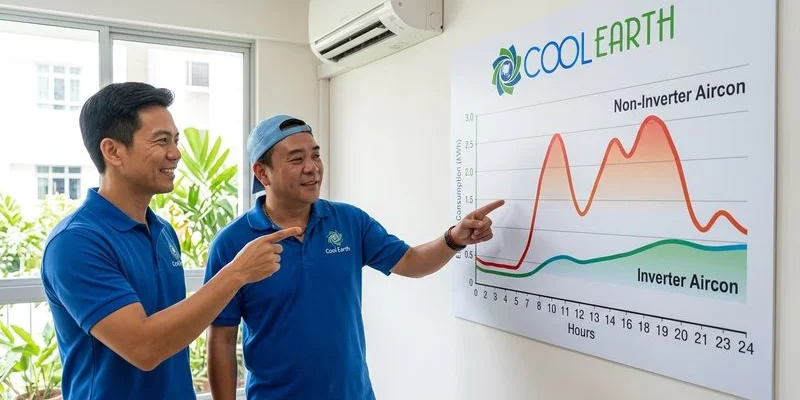
Brian founded Cool Earth Aircon in 2007 after completing his technical apprenticeship. With 18 years of hands-on experience servicing aircon systems across Singapore, he leads a team of certified technicians committed to transparent, quality work.