
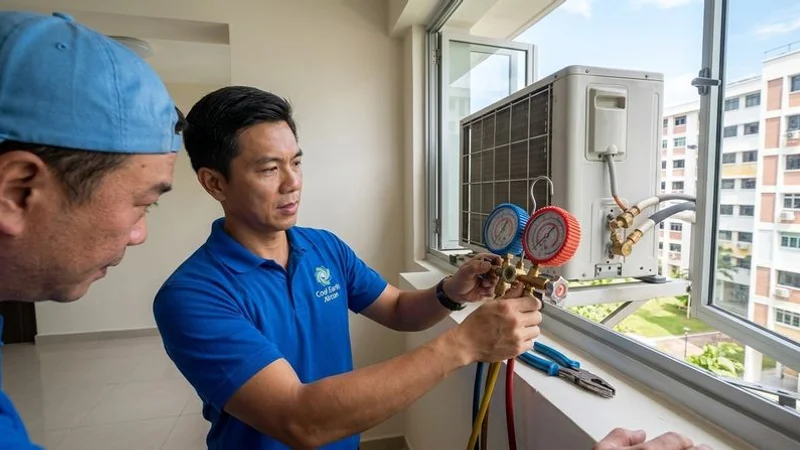
Since Brian started Cool Earth Aircon Services back in 2007, providing reliable aircon servicing in Singapore, we have seen countless older air conditioning units run perfectly right up until a routine service uncovers a major issue.
That specific problem is usually the refrigerant.
R22 gas is fading fast from the local market due to strict environmental phase-outs, leaving many property owners facing steep maintenance bills.
The National Environment Agency regulations have fundamentally shifted how cooling systems operate here. Let’s examine the exact differences between R22, R410A, and R32 gases, and outline the most cost-effective ways to manage your current setup.
Understanding Refrigerant Types
R22 (Chlorodifluoromethane)
Our experience since 2007 shows that R22 was the absolute standard for local residential cooling for decades. It cools effectively, but its high chlorine content severely damages the ozone layer. Under the Montreal Protocol, the Singapore government capped the import of R22 heavily.
Local technicians must now rely on dwindling stockpiles to service older units. The National Environment Agency tightly controls these imports. This means availability will inevitably hit zero.
R410A (Difluoromethane/Pentafluoroethane Blend)
Manufacturers replaced R22 with R410A around 2010 to eliminate ozone depletion entirely. Most systems installed in HDB flats and condos between 2010 and 2020 run on this chlorine-free blend.
We find that R410A operates at much higher pressures than its predecessor. You cannot swap the two gases, as older piping and compressors simply cannot handle the increased strain.
Here are the key facts about R410A:
- Zero ozone depletion potential.
- Requires synthetic polyester (POE) oil instead of the mineral oil used in older units.
- The National Environment Agency phased out the supply of new R410A household units by late 2022.
R32 (Difluoromethane)
R32 represents the newest standard for modern cooling appliances. Major manufacturers like Daikin and Mitsubishi Electric now exclusively use this gas for their latest models, such as the popular Daikin iSmileEco series.
It boasts a Global Warming Potential (GWP) of 675. This is roughly 68% lower than the environmental impact of R410A.
Our technicians appreciate that R32 also delivers superior energy efficiency. While classified as mildly flammable (A2L), the Singapore Civil Defence Force approves it for residential use. The small volume of gas in a home unit dissipates rapidly and poses virtually no fire risk in a ventilated space.
Key Differences at a Glance
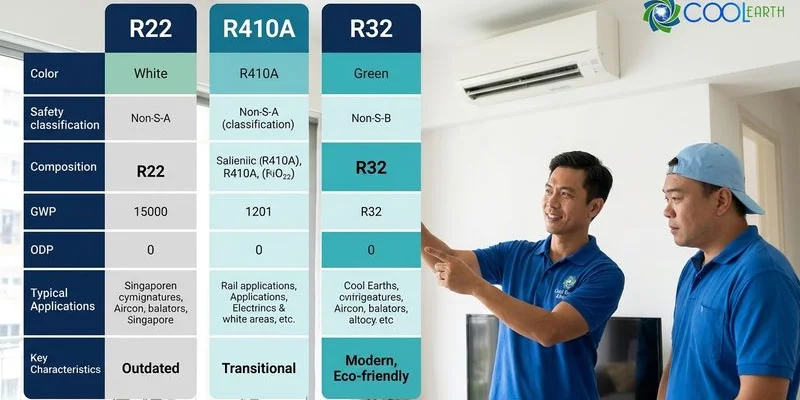
| Property | R22 | R410A | R32 |
|---|---|---|---|
| Ozone Depletion | Yes | No | No |
| Global Warming Potential | 1,810 | 2,088 | 675 |
| Operating Pressure | Lower | Higher | Higher |
| Energy Efficiency | Standard | Good | Best (10-15% savings) |
| Flammability | No | No | Mildly (A2L) |
| Availability in SG | Highly Restricted | Good | Excellent |
| 2026 Top-up Cost | S$80 to S$150 | S$80 to S$120 | S$80 to S$120 |
| Market Status | Phased out | Legacy standard | Current standard |
How Does This Affect You?
If Your System Uses R22
The immediate impact on your wallet is the rising cost of maintenance. R22 prices have surged due to artificial scarcity created by strict import quotas.
A basic gas top-up that cost S$50 a few years ago now ranges from S$80 to S$150 in 2026. We recommend keeping your current unit only if it cools well and rarely needs servicing.
Frequent leaks mean you are pouring money into a dying system. A major compressor failure is the exact point where upgrading to a modern R32 setup becomes vastly cheaper than paying for an obsolete repair.
If Your System Uses R410A
Homeowners with R410A units are in a secure position for the time being. The gas remains readily available across local suppliers, ensuring normal servicing costs.
Industry standards dictate that spare parts for these systems will remain in circulation for about five to seven years post-phase-out. You do not need to replace a functioning R410A unit right now.
Our advice is to stick to your routine chemical washes and top-ups as needed. There is no financial benefit to discarding a working R410A system prematurely.
If Your System Uses R32
Operating an R32 system means you have the most efficient technology currently available. These modern units consume about 10% to 15% less electricity than older R410A equivalents.
Our maintenance teams use specific electronic leak detectors for R32, as older flame-based tools are unsafe for mildly flammable gases. Ensure your hired technician holds the right certifications to handle A2L refrigerants safely.
Should You Upgrade from R22?
Deciding to scrap an old system comes down to simple mathematics and cooling performance. With Q1 2026 electricity tariffs at approximately 29 cents per kWh, running an outdated compressor is highly expensive.
Switching from a 3-tick R22 system to a modern 5-tick R32 system can save a typical Singaporean household between S$360 and S$600 annually.
Consider an immediate replacement if you spot these warning signs:
- The equipment is over 12 years old.
- You require a gas top-up more than once a year. Knowing the signs of low refrigerant helps you catch leaks early.
- Monthly electricity bills are spiking without a change in usage.
- A major component like the printed circuit board has failed.
We must clarify that you cannot retrofit an R22 setup to accept new gases. The entire infrastructure requires a complete replacement. New systems operate at higher pressures that will easily rupture old copper pipes.
Can You Mix Refrigerant Types?
You must never mix different air conditioning gases. Each refrigerant requires a specific chemical composition and distinct lubricating oils to function properly.
Older R22 setups use mineral oil, whereas R410A and R32 systems rely on synthetic polyester oils. Mixing these incompatible oils creates a thick sludge that instantly destroys the compressor.
Any technician offering to top up your older system with a newer gas to save money is giving terrible advice. Mixing gases will cause:
- Poor cooling performance: The varied boiling points ruin the thermal exchange process.
- Catastrophic mechanical failure: The compressor will overheat and seize completely.
- Severe safety hazards: Unpredictable pressure levels could burst the copper lines.
How to Check Which Gas Your System Uses
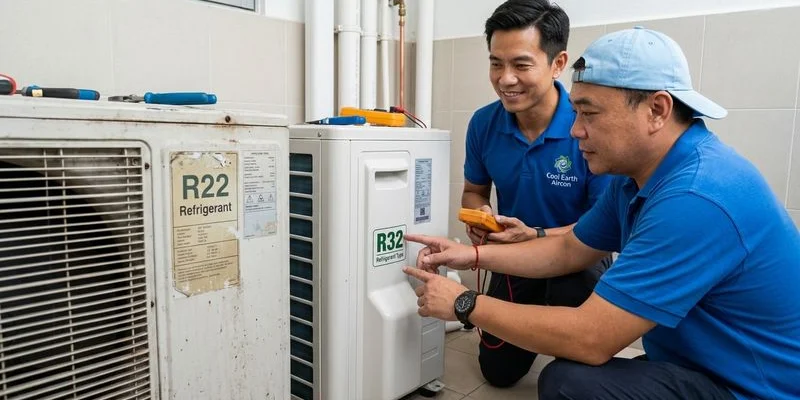
Identifying your gas type takes only a few minutes. The manufacturer always prints the refrigerant specification on the outdoor condenser’s metal nameplate.
Look for a sticker listing “Refrigerant” or “Gas Type” followed directly by the specific chemical code. If the sun has bleached the label, age is a highly accurate indicator.
- Pre-2010 Installations: Almost guaranteed to be R22.
- 2010 to 2018 Installations: Most likely running on R410A.
- 2019 Onwards: Generally R32, especially models from leading brands like Daikin or Mitsubishi.
Our service crews can also test the system pressure and inspect the valve fittings during a standard maintenance visit. This confirms the exact gas type without any guesswork.
Looking Ahead
Singapore will continue tightening environmental regulations on household appliances. The shift to R32 is practically complete, providing the ideal balance of excellent cooling, lower power consumption, and long-term availability.
Keeping your equipment updated protects you from sudden breakdowns during the hottest months.
If you are unsure what refrigerant your system uses or want advice on whether it is time to upgrade, contact Cool Earth Aircon for a free assessment. We will check your system, explain your options honestly, and help you make the right decision for your situation and budget.

About the Author
Brian
Founder & Lead Technician
Brian founded Cool Earth Aircon in 2007 after completing his technical apprenticeship. With 18 years of hands-on experience servicing aircon systems across Singapore, he leads a team of certified technicians committed to transparent, quality work.