
You know how frustrating it is when the indoor blower sounds perfectly fine, but the room stays uncomfortably warm.
Our team has seen this scenario countless times across Singapore HDB flats and commercial spaces. Cool Earth Aircon Services actually began back in 2007 as a one-man operation when Brian completed his technical apprenticeship. He set out to provide honest aircon servicing in Singapore that addressed root causes, not just temporary fixes.
Today, that same commitment drives how we diagnose cooling failures.
The difference between a weak airflow and a lack of cold air is a crucial distinction. A unit that blows air forcefully but lacks any chill usually suffers from a refrigerant deficiency. With Singapore electricity tariffs sitting at 29.11 cents per kWh in early 2026, forcing a starved compressor to run continuously is a fast way to inflate your monthly bills.
Before you call for a repair, you need to know the clear Signs Your Aircon Is Low on Gas (And What to Do About It). You will learn exactly what these warning signs look like. Then, we will detail the latest repair costs and the correct way to seal the system.
Recognizing the Signs Your Aircon Is Low on Gas (And What to Do About It)
This is the most frequent complaint heard during service calls. The indoor fancoil unit blows normally, but the temperature feels identical to the ambient room heat.
Our experts always check the temperature differential, also known as the Delta T. A healthy system should output air that is 10 to 15 degrees Celsius colder than the room temperature. You can measure this easily by placing a digital thermometer near the supply louvres.
If the gap is only 2 or 3 degrees, the system is struggling to absorb heat. The compressor still runs outside, and the fan still pushes air. We often find that less refrigerant in the copper coils directly reduces the cooling capacity per cycle.
An aircon that blows weakly is usually suffering from a clogged filter or a failing blower motor. Conversely, strong but warm airflow strongly points to a gas shortage.
Pro-Tip for Homeowners: Always check your remote control settings first. Ensure the mode is set to “Cool” (the snowflake icon) rather than “Fan” before assuming the refrigerant is depleted.
Sign 2: Ice or Frost on the Copper Pipes
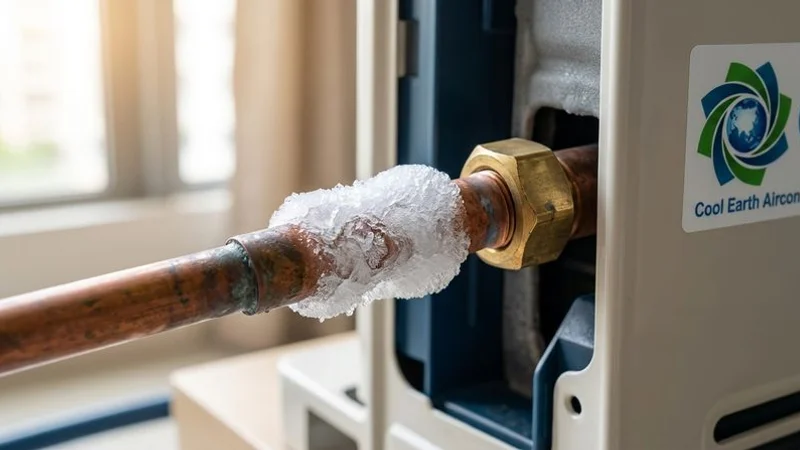
Inspect the insulated copper lines connecting your indoor fancoil to the outdoor condenser. You might spot a layer of white frost forming on the thinner liquid line.
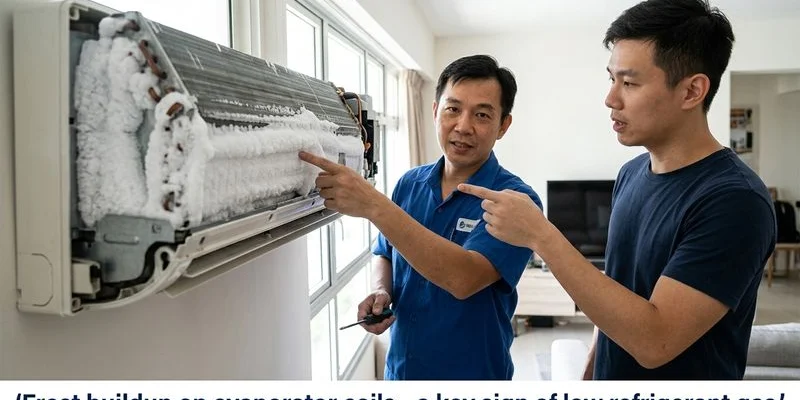
Our technicians consider this a definitive red flag for a pressurisation issue. When the pressure drops below normal operating thresholds, the evaporating temperature plummets below zero degrees Celsius. This unnatural freeze turns the normal condensation into solid ice along the evaporator coils.
You may even see chunks of ice if you lift the plastic front cover of the wall unit. In severe cases, the entire aluminium coil matrix becomes encased in a frozen block.
We strongly advise against chipping this ice away with household tools. Forcing the frost off will bend or puncture the delicate aluminium fins, causing irreversible damage. Instead, switch the system to fan-only mode for 30 minutes to melt the blockage safely.
Here are the most common areas to check for freezing symptoms:
- The liquid line: The thinner copper pipe at the condenser unit.
- The evaporator matrix: The aluminium fins hidden behind the indoor air filters.
- The flare nuts: The brass connection points on the outdoor unit.
Sign 3: The Indoor Unit Is Leaking Water
Water dripping from the indoor unit frequently indicates a clogged drainage pipe. However, a depleted refrigerant level triggers a very specific type of water leakage.
Our service crews often see this happen when the compressor cycles off. The thick layer of ice on the evaporator coils rapidly melts all at once. This sudden rush of water overwhelms the drain pan and spills down your wall.
To help you identify the root cause, review this quick diagnostic comparison.
| Symptom | Clogged Drain Pipe | Refrigerant Shortage |
|---|---|---|
| Leak Timing | Continuous drip while running | Sudden rush after turning unit off |
| Air Temperature | Normal cold air | Room temperature air |
| Visual Signs | Jelly buildup in the drain pan | Ice formation on coils and pipes |
Sign 4: The Compressor Runs Continuously
A properly charged non-inverter compressor will switch off once the target temperature is met. Inverter models will seamlessly slow down to maintain that comfortable climate.
Our energy audits reveal that a starved system never reaches the desired set point. The compressor is forced to run at maximum capacity endlessly. This relentless strain severely accelerates mechanical wear and tear.
It also causes a massive spike in your monthly utilities. At the Q1 2026 Singapore electricity rate of 29.11 cents per kWh, an overworked compressor can easily add 50 to 100 dollars to your bill.
We have seen homeowners pay more in wasted electricity than the cost of a proper repair. Running a compromised system eventually leads to complete compressor failure. Replacing a burnt-out compressor often costs upwards of 800 dollars, making early intervention critical.
Financial Warning: A compressor that runs 24 hours a day to compensate for low pressure will drastically reduce its operational lifespan from 10 years to barely 3 years.
Sign 5: Hissing Sounds and Smart Error Codes
Modern units are designed as closed-loop circuits, meaning the gas does not get consumed like car fuel. If the level drops, it is actively escaping through a physical breach.
Our diagnostic tools frequently detect small cracks near the flare nut connections. You might actually hear a faint hissing or bubbling noise from the indoor unit when the compressor starts. This sound is the pressurised liquid squeezing through a microscopic pinhole.
Reading the Error Codes
Many modern systems now self-diagnose these pressure drops before you hear anything. Checking the front panel for blinking lights or digital codes can save you hours of guessing.
We highly recommend checking your specific brand documentation, but here are the most common alerts in Singapore.
- Mitsubishi Electric (City Multi & Starmex): Look for Error Code 1301, which specifically flags a low pressure fault.
- Daikin: The system will often display a “U0” code on the remote to indicate a refrigerant shortage.
- Panasonic: The timer light will blink continuously, and you can extract the exact fault code using the remote control test button.
Why Does Refrigerant Gas Run Low?
Many property owners mistakenly assume that air conditioners need annual gas refills. This is a widespread misconception that leads to wasted money.
Our team stresses that the cooling circuit is completely sealed at the factory. The volume only drops if there is an active leak in the piping or joints. A top-up without a repair is just a temporary bandage.
Here are the most frequent structural failures that cause a drop in pressure:
- Flare Nut Connections: The brass joints connecting the copper pipes expand and contract daily, eventually loosening the seal.
- Copper Pipe Degradation: Moisture and vibration fatigue can create micro-cracks along the hidden pipe runs inside your walls.
- Evaporator Coil Corrosion: Formicary corrosion from household chemicals eats microscopic pin-holes into the aluminium coils over time.
- Schrader Valve Failure: The outdoor service port acts just like a bicycle tyre valve and can degrade under Singapore’s intense heat.
The 2026 Shift in Refrigerant Standards
The type of gas leaking from your system dictates how easily it can be fixed. The National Environment Agency (NEA) has aggressively phased out older, high-GWP (Global Warming Potential) chemicals.
Our compliance officers note that R22 was banned years ago, making it incredibly scarce and expensive to source in 2026. Even R410A units saw supply restrictions begin in late 2022.
Today, the industry standard is R32, which boasts a 68 percent lower environmental impact and higher energy efficiency. If you have a severely leaking R22 system, patching it is often less economical than upgrading to an R32 model. Our detailed R22 vs R410A comparison explains the differences.
What Does a Gas Top-Up Involve?
Throwing a canister on the outdoor unit and guessing the pressure is a recipe for disaster. Proper restoration requires precision tools and a methodical testing process.
Our standard operating procedure ensures the root cause is actually resolved. Here is the exact workflow a professional technician should follow at your property.
- Pressure Diagnosis: A digital manifold gauge is attached to the outdoor service valves to record the exact system pressure and temperature.
- Leak Detection: The technician uses an electronic sniffer or a specialised UV dye to pinpoint the exact location of the micro-fracture.
- Targeted Repair: Minor flare joint leaks are re-tightened or re-flared immediately. Larger coil leaks require silver-brazing or a full component swap.
- Vacuum and Charging: The system is evacuated of air, and the correct weight of refrigerant is injected based on the manufacturer’s data plate.
- Performance Testing: The unit runs for 20 minutes to verify the Delta T temperature gap is restored and the leak is sealed.
Cost of a Gas Top-Up in Singapore
Pricing for this service depends heavily on the chemical required and the severity of the depletion. The regulatory phase-outs mentioned earlier have directly impacted the market rates.
Our updated 2026 gas top-up price guide reflects the current supply landscape across the island. Be cautious of quotes that seem unusually low, as they often skip the vital leak detection phase.
| Refrigerant Type | Estimated 2026 Cost (SGD) | Market Status |
|---|---|---|
| R22 | $100 to $130 | Phased out. Increasingly rare and expensive to source. |
| R410A | $130 to $165 | Restricted supply for new units, but still common in repairs. |
| R32 | $130 to $180 | The current standard. Highly efficient and widely available. |
Keep in mind that these figures cover the diagnostic and the chemical charge. Extensive soldering or pipe replacement will require a separate quotation based on the labour involved.
When to Call a Technician
Identifying the Signs Your Aircon Is Low on Gas (And What to Do About It) early is the best way to save your equipment. The compressor relies on the returning cool gas to prevent itself from melting down.
Our technicians urge you to power down the unit the moment you notice frost or a weak Delta T. A minor joint repair and refill is a fraction of the cost of a full compressor replacement.
Contact Cool Earth Aircon for a same-day diagnostic. We will connect our gauges, identify the hidden leaks, and provide a transparent, flat-rate quote before any tools are lifted.
Do not let a minor leak ruin your summer comfort or your electricity budget.


About the Author
Brian
Founder & Lead Technician
Brian founded Cool Earth Aircon in 2007 after completing his technical apprenticeship. With 18 years of hands-on experience servicing aircon systems across Singapore, he leads a team of certified technicians committed to transparent, quality work.