
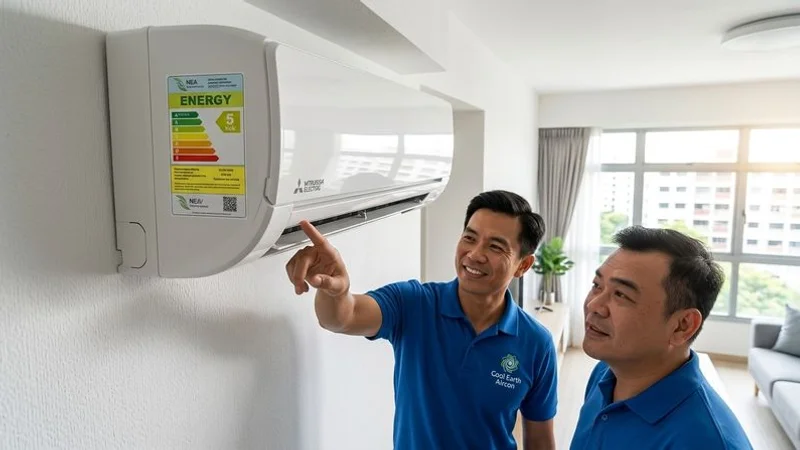
You know how every time we quote a new installation, the first thing clients look at is that bright green sticker on the front?
They spot the row of ticks, automatically assume a higher number guarantees better cooling, and sign off on the purchase immediately.
Understanding aircon energy labels in Singapore is absolutely crucial before you make that payment.
From what we have observed over 18 years of professional aircon servicing in Singapore at Cool Earth Aircon Services, brushing past the rest of the label data is a costly mistake. That green sticker actually holds the exact mathematical formula for your future electricity bills.
We are going to break down exactly what the National Environment Agency (NEA) rating tells us and look at the recent minimum standards. Let us explore the fine print so you can maximise your long-term savings.
Understanding Aircon Energy Labels in Singapore: The MELS Framework
Singapore’s energy labelling scheme for air conditioners is administered by the National Environment Agency (NEA) under the Environmental Protection and Management Act. Every single-split and multi-split aircon unit sold in the country must display this certification. The label is a strict legal requirement rather than a voluntary marketing badge.
We have seen a massive regulatory shift recently that completely changes the buying landscape. Effective from April 1, 2025, the NEA drastically raised the Minimum Energy Performance Standards (MEPS) for residential cooling systems. The new baseline legal requirements for selling split-type aircons in Singapore are:
- Single-split aircons: Minimum 4-tick rating
- Multi-split aircons: Minimum 5-tick rating
- Portable aircons: Minimum 1-tick or 2-tick rating (introduced in April 2024)
If you see a brand new split-system unit in a 2026 showroom without these minimum ratings, that is an immediate red flag. The government is actively phasing out inefficient systems to lower national carbon emissions.
Anatomy of the Energy Label
The label contains five key pieces of information. Here is what each one means.
1. Tick Rating (1 to 5 Ticks)
The most prominent feature is the tick rating, displayed as green ticks on a scale of 1 to 5. This system represents the Cooling Seasonal Performance Factor (CSPF), which measures how efficiently the unit converts electricity into cooling.
- 1 and 2 Ticks: These represent the lowest legal efficiency and are now mostly found on portable or older window units.
- 3 Ticks: This was considered average performance back in 2020 but is now falling behind current standards.
- 4 Ticks: This marks high efficiency and is the new legal baseline for single-split systems.
- 5 Ticks: These units offer the absolute best energy performance available on the market today.
Our technicians always remind clients that tick thresholds are periodically tightened by the NEA. A unit that earned 4 ticks back in 2018 might only earn 2 ticks under the strict 2026 standards. Newer 5-tick models primarily use R32 refrigerant, which runs circles around the older R410A gas in terms of power savings. Comparing tick ratings across different model years will give you a highly inaccurate picture of efficiency.
2. Annual Energy Consumption (kWh/year)
This figure estimates the total electricity the unit will consume in a year under standardised test conditions. The testing framework typically assumes a specific daily usage pattern, such as running the unit for 8 hours per day in a standard enclosed room.
This raw number is highly useful for comparing different models of the exact same capacity. If two 12,000 BTU units show an annual consumption of 750 kWh and 900 kWh respectively, the first unit will cost you approximately 20% less to run.
Your actual consumption will always differ from the printed label figure. The test conditions simply cannot account for real-world variables like poor room insulation or extreme afternoon sun. If you work from home and run the aircon for 12 hours a day instead of 8, your consumption will scale up proportionally. We advise using the label figure strictly as a comparison tool rather than an absolute guarantee of your future bills.
3. Annual Energy Cost (S$)
This is the estimated annual electricity cost based on the annual energy consumption figure. It provides a quick financial snapshot by multiplying the kWh estimate by the prevailing electricity tariff at the exact time the label was printed.
Electricity tariffs change every single quarter in Singapore based on SP Group reviews. The cost shown on the label uses the tariff rate that was current on the day of manufacturing, which almost never matches today’s exact rate. You will need to calculate the math manually to get an accurate projection.
As of the first quarter of 2026, the prevailing SP Group electricity tariff is 29.11 cents per kWh (inclusive of GST). A unit rated at 800 kWh per year would cost roughly S$233 per year to run based on this specific 2026 rate. This breaks down to a highly manageable S$19.40 per month in electricity costs.
The 2026 Cost Formula: Annual kWh × S$0.2911 = Your Estimated Yearly Cost
4. Cooling Capacity (BTU/h or kW)
This metric tells you the unit’s maximum cooling output. It represents exactly how much heat the system can pull out of your room per hour, measured in British Thermal Units per hour (BTU/h) or kilowatts (kW).
Choosing the precise capacity for your room is critical for both comfort and energy efficiency. A standard HDB master bedroom typically requires a 9,000 BTU unit to cool down effectively. A larger living room layout will demand anywhere from 18,000 to 24,000 BTU depending on the floor plan.
We often see homeowners make the expensive mistake of buying an undersized unit to save money upfront. An undersized 9,000 BTU system placed in a massive living room will never stop running to reach the target temperature. This constant strain completely negates any 5-tick efficiency benefits and destroys the compressor prematurely.
5. Energy Efficiency Ratio (EER) or Coefficient of Performance (COP)
The EER (for cooling) or COP (general) is the exact ratio of cooling output to electrical input. A higher number indicates that the system generates more cooling power for every single watt of electricity it consumes.
Let us look at a practical technical comparison:
- A unit with an EER of 3.0 produces 3 watts of cooling for every 1 watt of electricity consumed.
- A unit with an EER of 4.0 produces 4 watts of cooling for every 1 watt consumed, representing a massive 33% jump in efficiency.
The EER is the most technically accurate measure of efficiency and forms the mathematical basis for the entire tick rating calculation. For context, under the latest 2025/2026 NEA standards, a split-type aircon with an inverter needs a weighted COP of at least 4.04 just to qualify for the minimum legal tiers. When comparing two units with the exact same tick rating, the model with the higher EER is the superior choice.
How Much Do Ticks Really Save?
Let us put concrete numbers to these efficiency ratings. For a standard 12,000 BTU (3.5 kW) unit running 8 hours per day, the differences become obvious when we apply the Q1 2026 electricity tariff of S$0.2911 per kWh.
We compiled this comparison to show the exact financial gap between different efficiency tiers:
| Rating | Approx. Annual kWh | Annual Cost (S$0.2911/kWh) | Savings vs 1-Tick Old Unit |
|---|---|---|---|
| 1 tick | 1,100 kWh | S$320 | Baseline |
| 2 ticks | 950 kWh | S$276 | S$44/year |
| 3 ticks | 830 kWh | S$241 | S$79/year |
| 4 ticks | 720 kWh | S$209 | S$111/year |
| 5 ticks | 620 kWh | S$180 | S$140/year |
Over a typical 10-year lifespan, a new 5-tick unit saves approximately S$1,400 in electricity compared to an old 1-tick unit. The difference between a 3-tick and 5-tick unit still amounts to about S$610 over a decade of use.
Given that the initial price premium for a premium 5-tick unit over a standard 3-tick model is typically S$200 to S$400, the investment pays for itself entirely within 4 to 6 years. You get to enjoy lower monthly bills and a quieter, more advanced cooling system for the second half of its lifespan.
Inverter vs Non-Inverter on the Label
Both inverter and non-inverter units are rated on the exact same MELS label system. The printed label applies strictly to the rigid test conditions described in the laboratory paperwork.
In standard residential practice, modern inverter units tend to perform far better than their label suggests. The variable-speed compressor operation is incredibly efficient during steady-state cooling because it smoothly adjusts output instead of abruptly shutting off and on.
Non-inverter units perform closest to their label rating only when used in short, aggressive bursts with significant off periods. This specific usage pattern is highly uncommon in Singapore’s year-round tropical climate. You will find that almost all 4 and 5-tick residential units sold locally in 2026 are advanced inverter models, as non-inverters simply cannot pass the strict new energy thresholds.
Common Mistakes When Using Energy Labels
Buyers frequently misinterpret the label data and end up purchasing the wrong system. Here are the most frequent errors we correct during our consultations.
Comparing Different Capacities
Tick ratings are assigned strictly within specific capacity categories. A massive 5-tick 24,000 BTU unit will always consume significantly more electricity than a standard 3-tick 9,000 BTU unit simply because it is a much larger machine.
The green ticks only compare efficiency against other models of the exact same size. You must select your required BTU first before looking at the tick ratings.
Ignoring the kWh Figure
Two units boasting the exact same tick rating can easily have different actual power consumptions. Within the premium 4-tick range, one specific brand might consume 700 kWh per year while a competitor consumes 740 kWh per year.
The annual kWh figure gives you a much more precise comparison than the broad tick category. Our technicians advise clients to treat the kWh number as the final tiebreaker between two similarly priced models. Look out for these specific variables on the sticker:
- The Model Number: Ensure you are comparing the exact same product generation.
- The kWh Output: A 40 kWh yearly difference adds up over a decade.
- The Test Conditions: Standard labels assume identical room dimensions and 8-hour daily runs.
Assuming Labels Are Current
Energy labels are physically printed at the time of manufacture and frequently use outdated electricity tariff rates. A unit built in 2023 will display a much lower estimated annual cost than the reality of 2026 pricing.
Always grab your phone and recalculate the cost using the current SP Group tariff. This simple 10-second math exercise guarantees a completely accurate financial comparison.
Forgetting Multi-Split Efficiency Variables
For multi-split systems, the sticker on the indoor blower only reflects that specific unit’s efficiency rating. The total system efficiency relies heavily on several external installation factors:
- The condition of the outdoor condenser unit.
- The exact length and routing of the copper pipes.
- The thickness and quality of the pipe insulation.
A poorly installed 5-tick system with thin insulation will easily perform worse than a perfectly installed 3-tick system. This is exactly why the April 2025 regulations mandated that all new multi-split systems hit the 5-tick standard, forcing the entire industry to elevate its baseline quality.
Our Practical Recommendation
When choosing a new air conditioner today, we strongly advise securing the highest tick rating that fits within your renovation budget. The upfront cost difference is minimal when viewed over a 10-year timeline.
The 4 and 5-tick models are widely available at highly competitive prices across Singapore, and the guaranteed electricity savings make them the most logical financial choice. For practical ways to cut your power bills further, see our tips on reducing your aircon electricity bill.
If you find yourself comparing two distinct models with the exact same tick rating, pull up the annual kWh figure and the EER data. These two precise numbers will immediately reveal which machine is genuinely more efficient. You must also factor in the contractor’s aircon installation quality, as improper sizing or cheap copper piping will ruin the performance of the most expensive hardware on the market.
For help selecting the most energy-efficient aircon for your home, or for more tips on understanding aircon energy labels in Singapore, contact Cool Earth Aircon for a free consultation. We will analyse your floor plans and recommend the perfect model based on your room dimensions, daily usage habits, and exact budget.



About the Author
Brian
Founder & Lead Technician
Brian founded Cool Earth Aircon in 2007 after completing his technical apprenticeship. With 18 years of hands-on experience servicing aircon systems across Singapore, he leads a team of certified technicians committed to transparent, quality work.